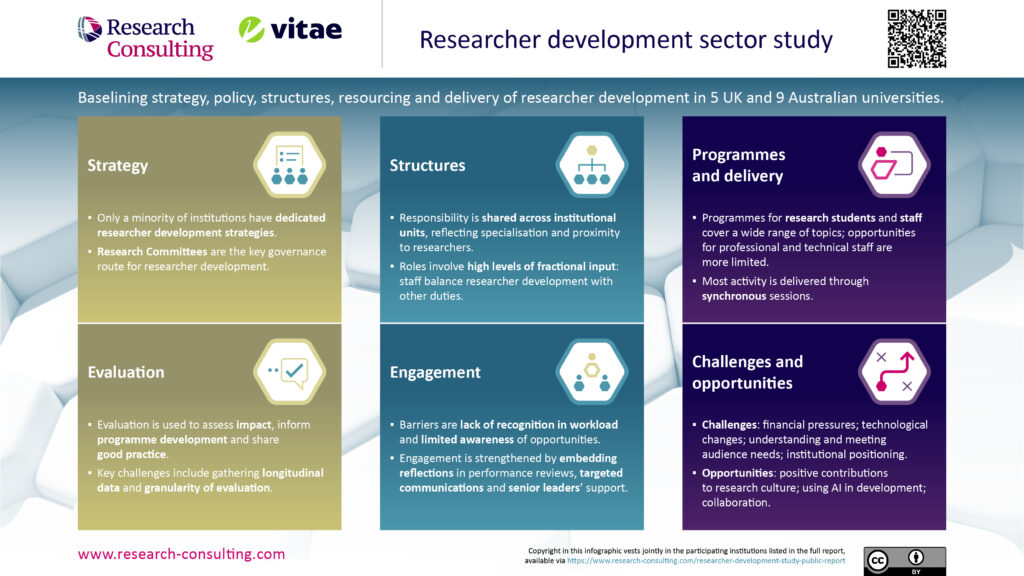
In line with the in-person element of the Vitae International Researcher Development Conference in September 2025, Vitae published the public report on our first international Researcher Development Benchmarking project, conducted in partnership with Research Consulting.
The report was the culmination of over a year’s effort during which the team worked closely with participating institutions (5 in the UK, and 9 in Australia) to dig deeply into their researcher development offering at many levels. We asked them to reflect carefully on the underlying motivations for offering RD, its strategic position within their governance structures, how it is staffed, resourced, delivered, and evaluated.
The report itself is rich in insights. For instance, the extraordinary volume and variety of provision offered by institutions with lean full-time central researcher development teams and decentralised “grassroots” provision was striking. Interestingly, the report suggests that there is no obvious relationship between the size of an institution’s researcher community and its level of “central” researcher development staff resourcing.
The report prompts readers to reconsider the notion of formally recognising development activities in workloads, and the optimum methods for raising awareness of opportunities within institutions. Critically, it also highlights the central importance (and challenge) of effective evaluation of researcher development provision, an area which Vitae is currently actively working to support and promote. It is essential reading for those who are interested in the specifics of how institutions develop their researchers.
By asking the questions and considering the fundamentals, participating institutions immediately started to view their activities through a different lens. Light was shed on transformative ongoing work, gaps were identified in offerings which otherwise would have remained obscure, and actions which could improve provision came into focus. Through collaborative workshops, innovative approaches to dealing with challenges were shared and discussed.
Business as usual can often be the norm, but by taking time, taking stock, and taking notice institutions were able to gain a fresh perspective on the shape of their RD provision. Many institutions were confident in their activities but wanted to establish a baseline for their future evaluation, others were at the end of a process of change and wished to see how they compared after all their hard work. All were keen to obtain an independent and impartial snapshot, to equip them with the data they need to make future decisions.
Highlights of the project were the good-practice sharing workshops, where complex issues were addressed and examples of progress were showcased. Conversation was rich with both senior decision makers and active researcher developers getting into the details. Our hope is that by bringing together institutions in this way over multiple events, partnerships and collaborations will emerge and far outlast the project itself. The early signs are encouraging.
This benchmarking approach reflects Vitae’s commitment to building the evidence base for researcher development and sharing it with the sector. Alongside insights from CEDARS and other projects, this work strengthens the basis for more informed decision-making across the community.
Read the report here and sign up for news on future iterations
Blog authors: Dr Peter Boddy and Dr Yolana Pringle