Research Culture
What does research culture mean?
The term ‘research culture’ refers to the behaviours and values that influence how research is conducted and how people experience the environment in which research happens (Royal Society). Positive research cultures are often described in terms of being inclusive, collaborative, supportive, open, rigorous, and/or accessible, but there is no single definition. It is up to individuals, research groups, organisations and sector bodies to set their own vision and priorities for research culture.

Exploring research culture across Northern Ireland, 2025
Vitae is proud to have delivered a new report for Research Culture Northern Ireland (RCNI), Exploring research culture across Northern Ireland, the first system-wide review of its kind.
Through surveys, interviews, focus groups and desk research, the study explores how people experience research culture across higher education, government, industry and the voluntary sector. It highlights a connected and talented community with strong collaboration, and identifies opportunities to create a more open, sustainable and inclusive environment for research and innovation.
As Northern Ireland develops its new R&I strategy, the findings provide timely evidence to inform policy, strengthen partnerships and invest in research talent.
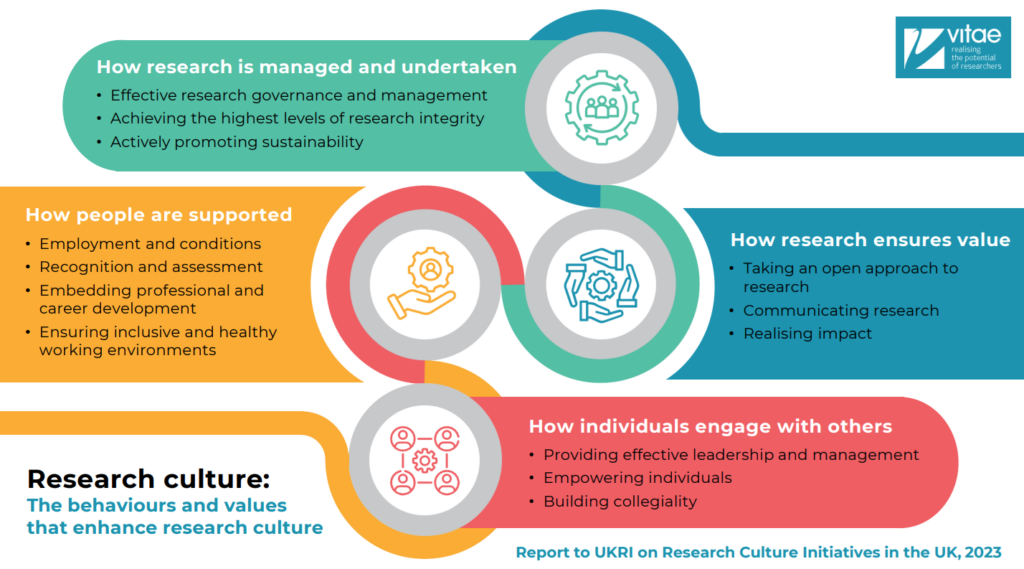
The Research Culture Framework
Following on from the launch of the Research Culture Initiatives in the UK (2023) report and as part of the same project commissioned by UK Research and Innovation, Vitae is proud to have developed the Research Culture Framework, in collaboration with Shift Insight and the UK Reproducibility Network (UKRN).
The Research Culture Framework is a tool for employers, funders, and policymakers to support strategic planning on research culture, and describes 13 elements of research culture across four themes:
- How research is managed and undertaken
- How research ensures value
- How people are supported
- How individuals engage with others
Each element of research culture is described in terms of values and behaviours, and provides a way of understanding the breadth of what is encompassed by research culture.
The framework has been designed for use in multiple contexts depending on the research setting, to help progress the research culture agenda. Based on your priorities, you can use the framework to:
- Facilitate conversations on research culture between researchers, research enablers, research participants, employers, and other key stakeholders
- Co-develop research culture definitions, priorities, and goals
- Conduct gap analyses, considering available evidence and existing policies and practices
- Create targeted action plans, prioritising actions to address gaps and agreeing measurable outcomes
The Research Culture Framework reflects sector perspectives from a wide range of role holders across a variety of institution and organisation types, as well as from individuals identifying as LGBTQ+, disabled, Black and minority ethnic, and women.
REF 2029 People, Culture and Environment Indicators project
In January 2024, the UK funding bodies commissioned a major project to develop the indicators, framework and submission template for assessing People, Culture and Environment (PCE) in REF 2029. The commission was awarded to Technopolis and Vitae, working in collaboration with a range of national partners representing the research culture, research integrity, equality and inclusion, and research leadership communities.
The project adopted a co-creation approach, involving extensive sector-wide engagement to ensure that the resulting framework was both widely supported and practicable for institutions. This collaborative methodology enabled the integration of evidence, expert insight, and lived experience from across the research community, helping to develop a meaningful and workable method for assessing institutions’ stewardship of research culture.
Project Aims
The project aimed to:
- Develop a set of indicators that institutions could use to evidence their People, Culture and Environment (PCE) activity.
- Produce a draft submission template and assessment framework for PCE, tested through the REF 2029 PCE Pilot.
- Provide recommendations to the funding bodies on the use and practical implementation of these indicators.
These aims reflected the growing recognition that healthy, inclusive and responsible research cultures are essential to delivering high-quality research.
For more information on the project click here.
REF 2029 People, Culture and Environment Indicators Project – Final Report
The final report published in December 2025 presents the proposed framework, indicators and submission templates for assessing People, Culture and Environment in the REF 2029 PCE Pilot. It brings together insights from desk research, national workshops, a large-scale survey, and iterative feedback from participating institutions and pilot panels to form a robust, practical and equitable approach to assessing research culture.
The report was authored by Technopolis and Vitae, with contributions from:
- Association of Research Managers and Administrators (ARMA)
- UK Reproducibility Network (UKRN)
- Future Leaders Fellows Development Network (FLFDN)
- National Association of Disabled Staff Networks (NADSN)
- Black Female Academics Network (BFAN)
- National Co-ordinating Centre for Public Engagement (NCCPE)
- Dr Elizabeth Gadd
- Professor James Wilsdon
- Professor Stephen Curry
The resulting framework supported a consistent, evidence-based and transparent approach to evaluating research culture across institutions for REF 2029.
It can be accessed via this link.