Publications

New Royal Society reports on diversity in early-career awards
Many research funders now develop and publish statistics on the diversity of those they fund, with some comparing the profile of awardees with that of applicants to see if their selection processes are inclusive or end up favouring or disfavouring particular groups. The Royal Society has been taking this a step further, with the assistance of The Careers Research and Advisory Centre (CRAC), for its early-career fellowship schemes, comparing those profiles with the diversity of those who are eligible to apply. This gives a fuller picture of their award-making, with the potential to shine a light on groups of researchers who potentially could but do not apply for their schemes. Such insights are obtained to inform the ongoing development of the Royal Society’s grant-making and other activities to broaden the participation of talented individuals of diverse backgrounds.
The Society has now published two reports produced for it by CRAC. The first attempted to establish the diversity profile of researchers in the UK eligible to apply for Royal Society early-career fellowships (updating previous work five years ago, but becoming increasingly difficult to do), which was then used to benchmark the diversity of applications to the schemes (results of which are in the second report). Overall, the exercise shows further progress being made but that applicants continue not to be fully representative of the profile of eligible applicants in the UK in certain respects, but with the schemes showing different variances. We feel the Society should be commended for attempting such benchmarking and being open in publishing the results and hope other funders will consider something similar.
Exploring research culture across Northern Ireland, 2025
Vitae is proud to have delivered a new report for Research Culture Northern Ireland (RCNI), Exploring research culture across Northern Ireland, the first system-wide review of its kind.
Through surveys, interviews, focus groups and desk research, the study explores how people experience research culture across higher education, government, industry and the voluntary sector. It highlights a connected and talented community with strong collaboration, and identifies opportunities to create a more open, sustainable and inclusive environment for research and innovation.
As Northern Ireland develops its new R&I strategy, the findings provide timely evidence to inform policy, strengthen partnerships and invest in research talent.
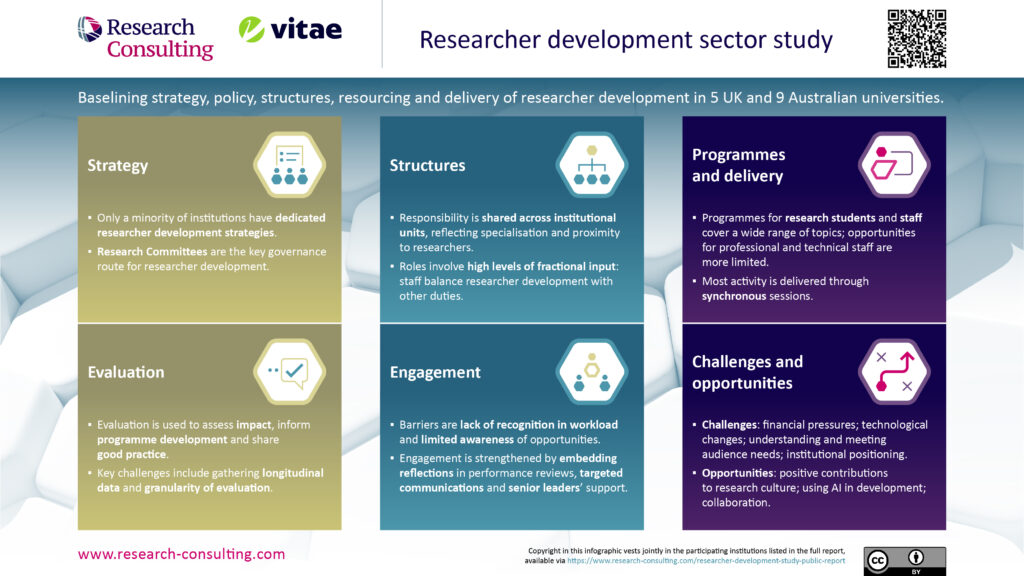
Building researcher capability
Building researcher capability: benchmarking report from Vitae and Research Consulting
Research Consulting and Vitae have conducted a baseline study of researcher development in 14 UK and Australian universities. The study examined challenges faced by these institutions, as well as their strategies, structure, resourcing, delivery, and evaluation, to provide insights.
Vitae annual reports
Each year Vitae puts together an annual report to share our achievements and activities from the previous year.

Executive Summary – The Path to Research Leadership in Africa
Executive Summary – The Path to Research Leadership in Africa
Read the 15 recommendations to all stakeholders, to accelerate world-class research, foster innovation, build linkages with policy makers and promote scientific leadership in Africa.
Exec Summary – Path to Research Leadership in Africa – FINAL – Feb ’20
Report – The Path to Research Leadership in Africa
Read the full report of this study on how they can play their part in developing the next generation and building the capacity and capability of current African research leaders.
Catalyst Fund: Supporting mental health and wellbeing for postgraduate research students
In March 2018, £1.5M was awarded to 17 projects through the Catalyst Fund to support the wellbeing and mental health of PGRs. Research England, UK Research and Innovation, and the Office for Students commissioned Vitae, in collaboration with Universities UK, to evaluate the programme’s impact, identify key learnings, and highlight effective practices. This report provides an overview of project activities, their reach and impact, and presents key themes and recommendations for the sector, senior institutional managers, supervisors, professional services staff, and PGRs.
Understanding the experience of postgraduate researchers (PGRs) using the Vitae Researcher Development Framework (RDF) at UK Universities – 2021
The project explored themes related to the RDF structure, language, and user experience, including how PGRs were introduced to the RDF, its benefits, and the institutional support provided. Based on key findings, the report offers recommendations for doctoral researchers, institutions, and the wider sector. In-depth interviews with PGRs informed case studies, contributing to Vitae’s RDF refresh project, UK HE policy, and PGR training development. Funded by the CHASE Doctoral Training Partnership, the project aims to enhance support for PGRs across institutions.
Understanding experience of PGRs using the Vitae RDF at UK Universities – Final June 2021 (1)

The impact of the Covid-19 pandemic on researchers and research – Wave 2 – June 2021
The ‘Wave 2’ survey, funded by UKRI and conducted by Vitae in early 2021, assessed Covid-19’s ongoing impact on UK researchers. Nearly half had returned to pre-pandemic hours, but over 80% had to adjust research methods, with reduced in-person contact hindering progress. Writing, peer review, and teaching increased, while wellbeing remained a concern, with 11% reporting bullying or harassment. Perceived funder support rose to 45%, though 51% of PGRs disagreed. The report highlights career concerns across all levels, though some researchers found unexpected opportunities.
The impact of Covid-19 on researchers and research
The Supervisor’s Voice
This report outlines the findings and recommendations of a six-month qualitative study that explored the extent to which UK based Arts Humanities and Social Sciences (AHSS) supervisors feel able and willing to support PGRs with matters not directly related to academic research, such as wellbeing and career development.

100 Years of the PhD – A history
Here I have attempted to write a short history of the PhD in the UK. Much is based on the excellent book from 1983 by Renate Simpson and also visits to the University of London and UCL archives to get some more specific information about my own University which has produced a significant number of UK PhDs. I begin with some words about mediaeval ‘doctorates’ and the research doctorate developments in the German speaking world which were most significant. The UK story is divided into four periods leading into some comments about the future. – Professor David Bogle

Developing the next generation: Guidance and good practice in the leadership development of early career researchers and academics
Research project outcomes, including toolkits for use by staff developers and academic and research leaders. Developed with funding from the Leadership Foundation for Higher Education.
Developing the next generation Vitae Brunel LFHE 2015
Research integrity: a landscape Study – June 2020
More publications
The Biotechnology and Biological Sciences Research Council (BBSRC) commissioned The Careers Research and Advisory Centre (CRAC) Ltd, that manages the Vitae programme, to evaluate the learnings and impact from the BBSRC ‘Professional Internships for the PhD Students’ (PIPS) scheme.
Launched in 2012, the PIPS scheme provides PhD students with the opportunity to gain work experience in a non-academic environment. The PIPS placement is mandatory for BBRSC funded PhD students; it usually lasts 12 weeks (about 3 months) and is unrelated to the PhD students’ doctoral research. The scheme aims to develop transferable skills, improve doctoral students’ understanding of different employment cultures and increase awareness of the wide spectrum of career opportunities.
The evaluation was completed in collaboration with the International Centre for Guidance Studies (iCeGS) based at the University of Derby, and focused on what the PIPS scheme adds to a doctoral degree in relation to students’ professional and career development. The findings suggest that:
- PIPS placements enhance a range of students’ skills and are likely to support their employability.
- There is evidence of PIPS placements having strong impacts on students’ development of career thinking.
Evaluation of the Professional Internships for PhD Students (PIPS) Programme
CRAC – Research into performing arts graduates’ careers: Exploring the careers and success of graduates of Conservatoire for Dance and Drama
CRAC – Evaluation of BBSRC Professional Internships for PhD Students: Evaluation of the Professional Internships for PhD Students (PIPS) Programme
CRAC – Identifying Good Practice Relating To Inclusive Selection Within The Future Leaders
Fellowship Scheme: Inclusive selection and support in the FLF
CRAC – Research Project: Qualitative research on barriers to progression for disabled
scientists: Qualitative research on barriers to progression of disabled scientists
CRAC – Exploring equality and diversity using REF2014 environment statements: Exploring equality and diversity using REF2014 environment statements
CRAC – Embedding career learning into doctoral programmes: Embedding Career Learning in PGR UKRI report
CRAC/Vitae: doctoral training in the arts and humanities report – UKRI
Research culture initiatives in the UK: report and appendices – UKRI
One size does not fit all – 2017