The impact of the Vitae Impact, Culture and Engagement (ICE) Awards 2025
The Vitae Impact, Culture and Engagement (ICE) Awards 2025 recognise the important work of researcher developers within the sector, to champion research culture change, to progress the careers of researchers, and to enable more positive research environments.
This year, the Vitae ICE Awards received 17 nominations across four award categories, with 15 different institutions entering nominees to be considered.
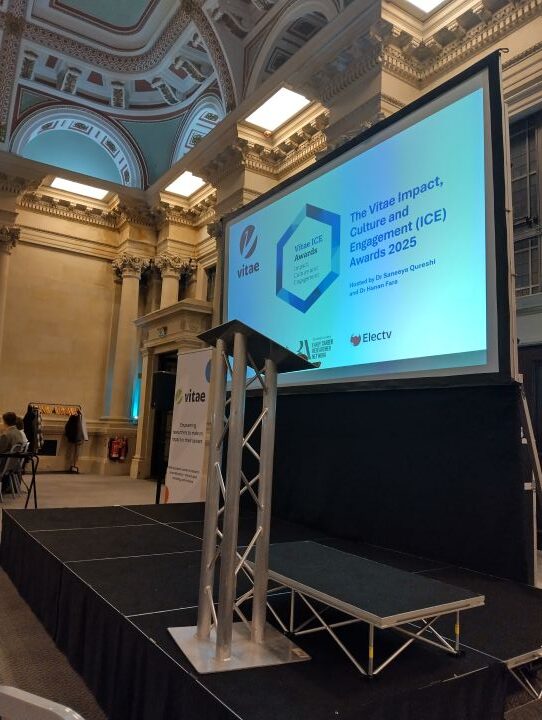
The Gala Dinner on Monday 22 September 2025 followed an inspiring first day of #VitaeCon2025, and took place at the Harbour Hotel in Bristol, with 240 attendees.
Congratulations to the four winners recognised below.
Newcomer of the Year Award
Dr Thomas Webb, Researcher Developer (PGR), Coventry University.
Tom was nominated for his contributions to postgraduate researcher development at Coventry University, where his work includes:
- creating a ‘post-viva support and planning’ workshop, which has been shared across networks;
- refreshing the ‘Launch, Plan, Write’ PGR induction programme, with this now an in-person event following a period of online delivery;
- coordinating the West Midlands PGR Training Network and delivering a successful Researcher Capability and Development Conference, amongst other initiatives.
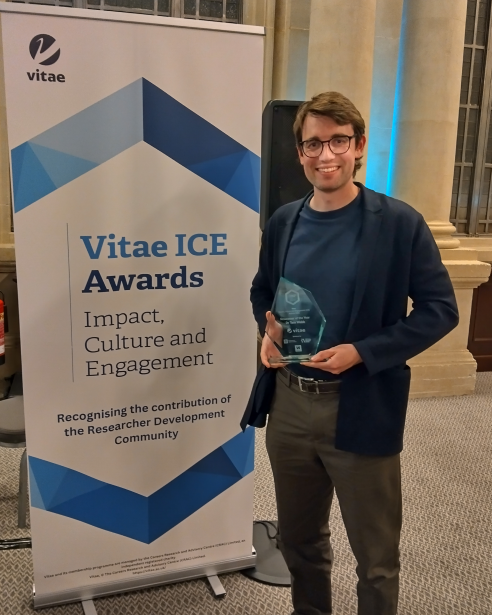
Outstanding Contribution Award
Dr Cosimo Inserra, Associate Professor, Cardiff University.
Cosimo was recognised by this award for his work to co-lead the first EDI Research Toolkit for Cardiff University, now being used to embed EDI into grant applications, lab structures and PhD supervision, to name a few.
Other notable work includes:
- as a member of the REF 2029 People and Diversity Advisory Committee, where he is advising on policies defining the Impact, and People, Culture and Environment elements, as well as the Code of Practice.
- He is Chair of the European Astronomical Society’s EDI Advisory Board, where he led a 32-country survey to gather data relevant to EDI policy within research culture.
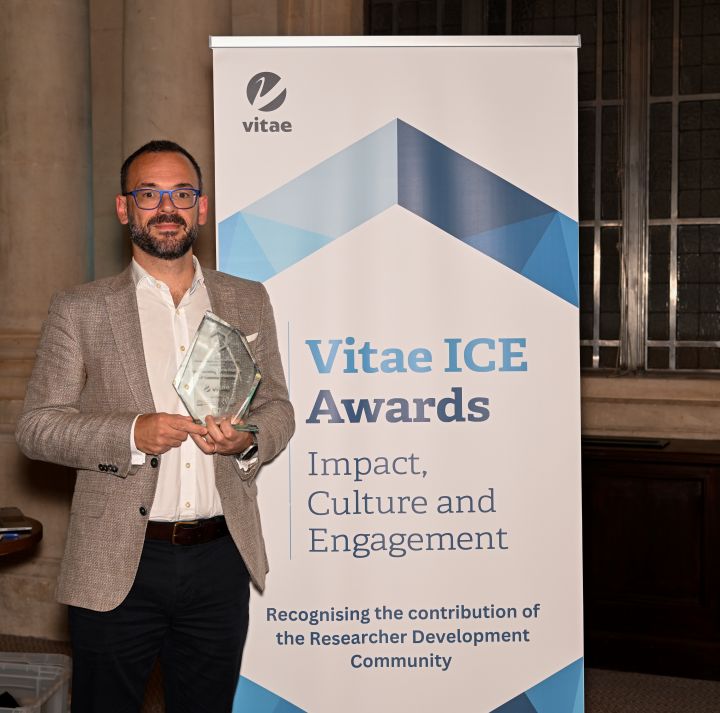
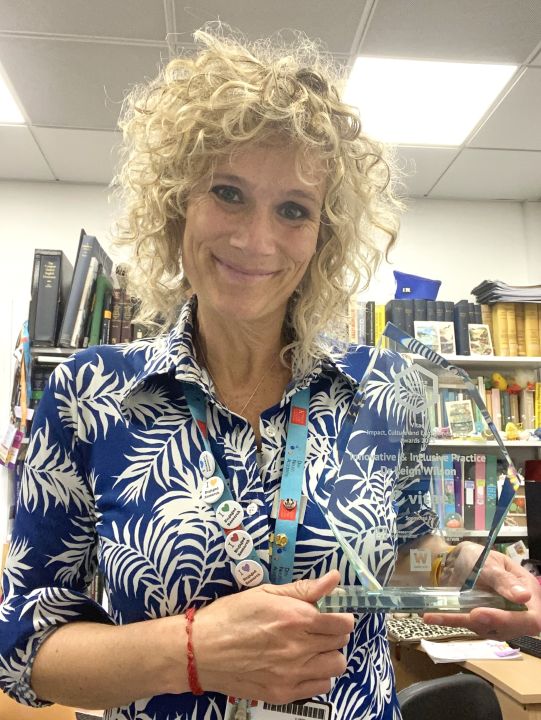
Innovative and Inclusive Practice Award
Dr Leigh Wilson, Public Engagement Manager and Outreach Lead for The Centre for Developmental Neurobiology, King’s College London.
Leigh has embedded innovative and inclusive practices across public engagement activities, and dismantled barriers through initiatives such as:
- the Black Brain Sci Showcase which elevates Black neuroscientists;
- Sunnydown Synaptic, a collaboration between a special needs school and PhD students to create accessible workshops;
- the Dev Neuro Academy (DNA) which connects 40 PhD and doctoral researchers with 60 Year 12 students from disadvantaged backgrounds, to strengthen mentorship, leadership and communication.
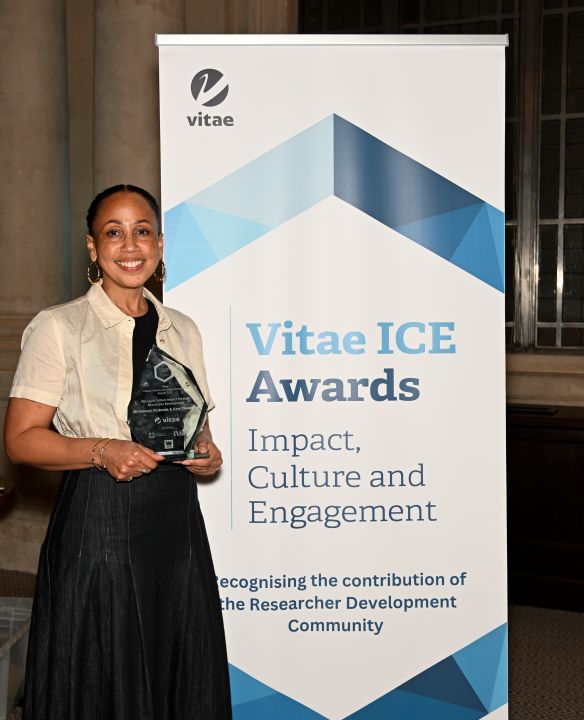
Research Culture Impact Through Researcher Development Award
Dr Deborah Husbands, Reader (Associate Professor) in Race and Sociocultural Psychology, University of Westminster and Kate Theophilus, Research Development Manager, University of Westminster, co-leads of the Black History Year Researchers Network.
- The Black History Year Researchers Network originated from an initial workshop in March 2023 for Black women colleagues at the University of Westminster.
- Since then, it has grown to 50 members and is open to all genders and runs sessions for Black colleagues to provide skills development and learning, combined with community-building, peer support and leadership support.
- Other researcher development activities include workshops, bid clinics, talks, and writing retreats to name a few.
The winners in their own words
Read about the experiences of the Vitae ICE Awards 2025 winners on winning their awards, as written by themselves in the texts below.
‘Receiving an award at the Vitae ICE Awards was both humbling and deeply affirming, not because it recognised an individual, but because it celebrated a shared commitment to improving research culture. What makes the ICE Awards so powerful is their focus on upscaling culture rather than spotlighting a single person. In doing so, they elevate everyone involved, acknowledging that meaningful and lasting change is always collective.
As I said at the ceremony, this recognition belongs to all those I have had the privilege of working alongside, particularly colleagues at Cardiff University / Prifysgol Caerdydd. Through collaboration, mutual support and a willingness to learn from one another, we have taken consistent steps towards a more inclusive, healthy and supportive research environment. Each step may feel small, but together they reshape how research culture looks and feels.
The ICE Awards offer a refreshing and much-needed perspective within academia. They remind us that anyone nominated has already made a difference. By giving time, energy and heart to this work, nominees and recipients alike contribute to a culture where people are valued, empowered and supported to grow.
In a sector where recognition can often feel individualised, the Vitae ICE Awards stand out for celebrating community, shared learning and collective progress. They
are a genuine breath of fresh air, and a powerful reminder that when we invest in culture together, everyone benefits.’
‘Winning Vitae’s Research Culture Impact through Researcher Development Award last year feels laden with meaning and lessons. It speaks to the power of collegiality: how colleagues who not only see the work you do but are generous enough to name it with a nomination, can spark a chain of events that spotlights quiet but important work. It speaks to the importance of communities of practice and gathering in person: the warmth, connections and conversations I had at the Vitae conference will stay with me for a long time. It speaks to the necessity of sharing our stories and taking up space: holding center stage for those few minutes of receiving the Award at the gala dinner, I spoke about my father, who came from recently independent Ghana to Birkbeck in London in the 60s to do a PhD in microbiology. Knowing how isolating the academy still is for Black Scholars, the fact he started it at all feels heroic and the fact he never finished no longer baffles me like it used to. I wonder how different his experience would have been with a Black History Year Researcher’s Network like ours at the University of Westminster, to find community in. We will be using our £250 Vitae Award to fund a PhD Development Grant to support the professional development of Black researchers at Westminster, match-funding from our resources so we can continue to offer an annual Award in recognition of Vitae’s recognition of us. It’s a deeply satisfying way to build on the impact this Award has already had in terms of visibility and affirmation for the work that we’re doing.’
‘Winning the Vitae Impact, Culture and Engagement (ICE) Award for Innovative and Inclusive Practice has offered a truly valuable moment to reflect on what has mattered most in my public engagement, involvement and researcher development work. For me, this centres on trust.
Bringing public engagement and researcher development together has been transformative, both in my own practice and in helping to build a more connected research culture within the neuroscience research department at King’s. Understanding and working sympathetically with the motivations, needs and values of researchers at all career stages is absolutely vital if engagement is to be meaningful and long-lasting. Inevitably, researchers experience different pressures, ambitions and anxieties, and public engagement only works when those realities are acknowledged. Listening carefully across the board and working to make inclusivity intentional for both researchers and engagement participants, establishes a safe space where people are willing to experiment, collaborate and take creative risks. This is where innovative approaches emerge.
Winning the ICE Award has helped make quieter, relational efforts more visible, and has highlighted the potential of this work to shape research culture in lasting ways. I hope it encourages others to recognise and nominate work that genuinely invests in people, relationships and care.’
‘If you are the line manager of someone who is relatively new to supporting researcher development, I would highly recommend putting them forward for the Vitae ICE Newcomer of the Year Award. I feel that the recognition of being nominated for the award by my colleagues at Coventry University has increased my confidence to pursue more dynamic initiatives to support the researcher community, especially against the backdrop of an evolving HE environment. It was an added bonus to have won.’

“This award is the product of a dream that started over 5 years ago, where we knew that Black histories and achievements deserved more than one month (October) of recognition. The University of Westminster Black History Year programme was born.(…) This is more than an award. This is a statement of empowerment for those holding intersections that may have worked against them in higher education. This award says: We see you.”
Dr Deborah Husbands, co-lead Black History Year Researchers Network
Reader (Associate Professor) in Race and Sociocultural Psychology
University of Westminster
“Absolutely delighted to have received the Innovative and Inclusive Practice Award from Vitae. Thank you Vitae for convening these awards which highlight the importance of the different areas of Impact, Culture and Engagement in research. Congratulations to the other winners…I am honoured to be included in such an awesome company.”
Dr Leigh Wilson
Public Engagement Manager and Outreach Lead
The Centre for Developmental Neurobiology, Kings College London
“I feel truly humbled to receive the Outstanding Contribution Award (…). This trophy is not just mine, it belongs to everyone I’ve had the privilege of working with, many of those at Cardiff University / Prifysgol Caerdydd. Through mutual support and collaboration, we’ve helped each other take consistent steps toward a better research culture, and every small shift has mattered. I also want to remind us all that anyone nominated for such an award (or any award) has already made a difference! By committing time, energy, and heart to this cause, we are all winners in changing the way research culture looks and feels in academia. I’m grateful for this recognition, but even more grateful to be part of a community where change is driven together.”
Dr Cosimo Inserra
Reader (Associate Professor)
Cardiff University